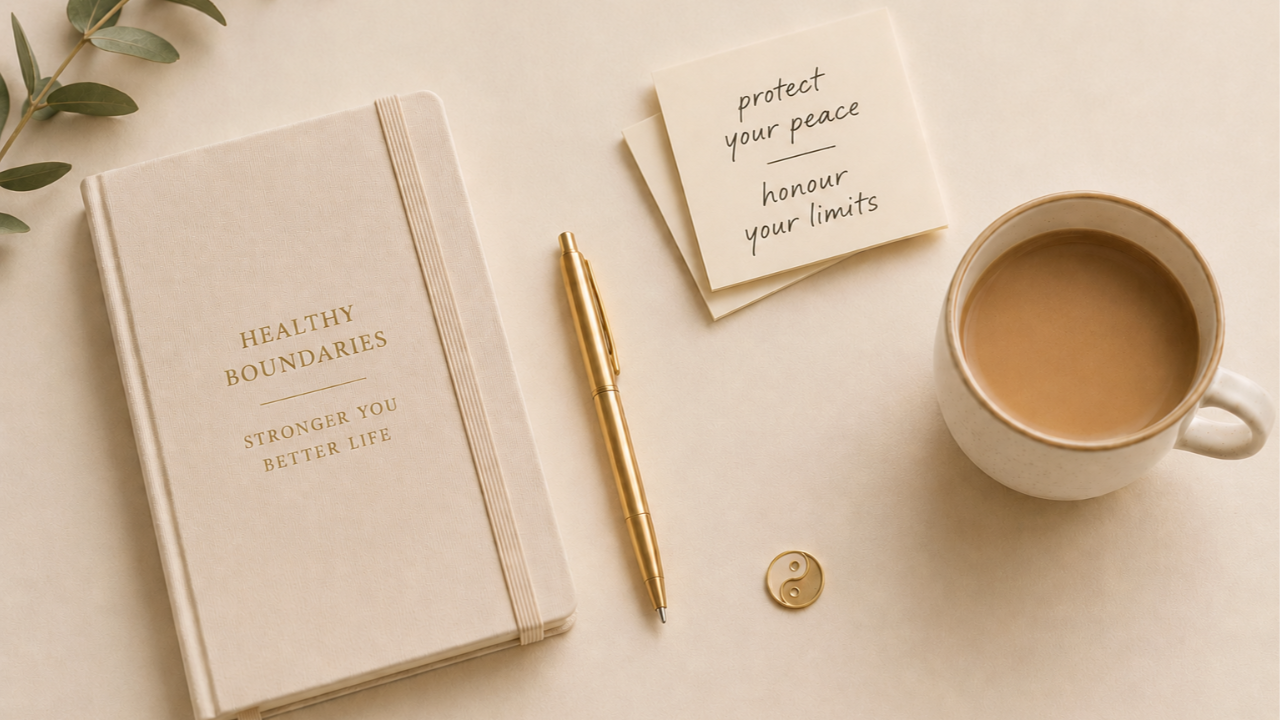
How to Stop People-Pleasing and Set Healthy Boundaries
Do you find it challenging to say no?
Do you worry about other people's reactions to your boundaries? Perhaps worrying about disappointing others, upsetting them, or even being seen as selfish if you put your own needs first?
Maybe you find yourself saying yes when you really want to say no. Maybe you avoid conflict, stay quiet when someone crosses a boundary, or constantly put other people's happiness before your own.
If this sounds familiar, you're certainly not alone.
Many people struggle with people-pleasing and setting healthy boundaries. Although we often understand, intellectually, that boundaries are important, putting them into practice consistently can feel incredibly challenging.
I know this because it's something I have struggled with myself. It feels like lifelong inner work - something I have to consistently practise and get better at.
When I look back at my life, I see that I have improved over time, but I'm certainly still learning. And I hope that what I've learnt along the way can help you in some way too.
What Is People-Pleasing?
People-pleasing is often misunderstood as kindness.
While kindness is a beautiful quality, people-pleasing is something quite different.
Kindness comes from a place of choice. It allows us to care for others while still honouring ourselves. People-pleasing, however, often comes at the expense of ourselves.
We ignore our own values, wants, and needs in order to avoid conflict, gain approval, or keep someone else happy. We say yes when we really want to say no. We stay silent when we need to speak up. We tolerate behaviour that doesn't feel right because we're afraid of what might happen if we assert ourselves.
Over time, this can leave us feeling emotionally drained, overwhelmed, frustrated, or even resentful.
Why Is It So Challenging to Set Healthy Boundaries?
There are many reasons why people struggle to set healthy boundaries.
Some of us fear rejection.
Some fear conflict.
Some worry that people won't like us anymore.
Others have simply spent so many years putting everyone else's needs first that they no longer recognise when one of their own boundaries has been crossed.
For me, it wasn't that I didn't understand what boundaries were; it was that asserting them felt uncomfortable. I noticed a pattern of the other person becoming frustrated or responding to my boundary with sarcasm, and it's this aspect that felt incredibly uncomfortable.
It was only later that I realised that only I can control my own emotions and responses. How other people respond is up to them. And, most importantly, how other people respond tells us a lot about who they are.
When you assert your boundaries, pay attention to how other people respond, because they're revealing something about themselves. Likewise, when others assert their boundaries with you, see it as an opportunity to reveal who you are - someone who is healthy, balanced, kind, and respectful.
Looking back, I can see that I often believed putting myself first was selfish, when in reality it was simply an act of self-respect.
That understanding changed everything.
Understanding It Through The Lens of Yin and Yang
One of the biggest breakthroughs in my own personal development came when I began studying the philosophy of yin and yang.
I realised that my people-pleasing wasn't simply about being "too nice."
It was an expression of excess yin.
Yin represents qualities such as kindness, compassion, empathy, flexibility, openness, and caring for others. These are qualities I deeply value and would never want to lose.
The problem isn't yin.
The problem arises when yin becomes excessive because it isn't balanced by healthy yang.
Healthy yang is what allows us to claim, communicate, and assert our boundaries. It gives us the confidence to be clear, firm, and direct while still remaining kind, empathetic, and considerate.
Without enough healthy yang, we may continually place other people's wants and needs before our own, struggle to say no, and find it difficult to honour our own boundaries (which moves us into the realm of excess yin and deficient yang).
Why Excess Yin Often Attracts Excess Yang
As I became more self-aware, I also began noticing a pattern within many of my relationships.
The more I people-pleased, the more I attracted people who expected me to continue doing so.
Some people would overstep my boundaries simply because I never communicated them clearly. Others naturally took up more space and control because I continually stepped back.
Within the philosophy of yin and yang, opposites attract.
When we live in excess yin, we often attract excess yang. For example, excess yin can include people-pleasing tendencies and a lack of assertiveness, while excess yang can include people who disrespect and overstep other people's boundaries, as well as being mean and unkind.
This doesn't mean the other person is entirely responsible for the relationship dynamic, nor does it mean that you are. While we cannot control another person's behaviour, we can always take responsibility for our own role, our own responses, and our own boundaries.
It's often much easier to focus on what someone else is doing wrong than to honestly ask ourselves where we can grow and evolve. Yet personal development begins when we become willing to look at our own role in the relationship dynamic.
For me, that began with one simple but powerful question:
Where am I not honouring and respecting my own boundaries?
That question was one of the most important questions I ever asked myself.
The Goal Isn't to Become Hard or Unkind
Sometimes people worry that setting boundaries means becoming cold, selfish, or uncaring (aka excess yang)
It doesn't.
The goal isn't to move from excess yin (people-pleasing and a lack of assertiveness) into excess yang ("my way or the highway" attitude).
It's to move towards healthy and balanced yin and yang.
That means remaining kind, compassionate, considerate, and caring, whilst also becoming clear, firm, and direct when communicating our boundaries, finding a healthy balance between the two.
You can care deeply about other people without abandoning your values, wants, and needs.
You can say no respectfully.
You can disagree without being disrespectful.
You can protect your own peace while still treating others with kindness and respect.
Start small. You don't have to begin by setting your biggest or most challenging boundary. It could simply be expressing your opinion, saying no to something you don't want to do, asking for what you need, or communicating honestly when something doesn't feel right.
Every time you honour one of your boundaries, you're strengthening your healthy yang whilst still allowing your healthy yin to shine through.
To me, this is what healthy boundaries really look like.
Awareness Comes First
One of the greatest lessons I've learnt is that awareness always comes before change.
We cannot change patterns that we cannot see within ourselves.
Often, our emotions quietly (or sometimes loudly) point us towards the boundaries we've been ignoring.
Feeling emotionally drained.
Feeling overwhelmed.
Feeling anxious.
Feeling resentful.
Feeling uncomfortable.
Feeling taken for granted.
These feelings are often invitations to become more self-aware and to ask ourselves whether one of our boundaries has been overlooked.
Rather than judging ourselves for these moments, we can become curious about them.
Awareness is where meaningful change begins. To me, self-awareness is at the core of personal development and creating positive change in our lives.
As your self-awareness begins to grow, start paying attention to the moments when you're about to people-please. Notice when you're about to say yes even though you really want to say no. Notice when you're staying quiet even though something doesn't feel right.
Before responding, simply pause and ask yourself:
- What do I really want?
- Am I saying yes because I genuinely want to, or because I'm afraid of the other person's reaction?
- Am I honouring my own values, wants, and needs?
You don't have to change your response immediately. Simply becoming aware of these moments is often the first step towards creating meaningful positive change.
This Takes Practice
One thing I've come to realise is that setting healthy boundaries isn't something we master overnight.
It's very easy to understand these ideas intellectually; living them consistently is something else entirely.
There are still moments when I hesitate. The difference now is that I'm more aware of them.
Instead of harshly judging myself, I simply notice what's happening and guide myself back towards that healthy and balanced middle point.
To me, this is lifelong inner work.
It isn't about becoming perfect. No one is perfect.
It's about becoming more self-aware, making healthier choices, and gradually creating new habits that honour and respect both yourself and others.
Be Kind and Patient With Yourself
If you struggle with people-pleasing or setting healthy boundaries, please be kind and patient with yourself.
These patterns often develop over many years, so it takes time to change them.
Every time you pause before saying yes; every time you honour one of your boundaries; every time you choose to respect your own values, wants, and needs, you are strengthening your relationship with yourself.
Remember that progress isn't measured by perfection. It's measured by awareness. Every time you notice yourself people-pleasing, you have another opportunity to choose differently. Sometimes you'll get it right, sometimes you won't, and that's okay. What matters is that you're becoming more aware.
Healthy boundaries are not about building walls or pushing people away. They are about creating healthier, more balanced, and self-aware relationships - with both yourself and with others.
And perhaps most importantly, remember that this is a journey. It's a cliché, I know, but it truly is. It takes time, effort, and consistent action, with no end date in place.
Kind of like an upward-moving spiral, where we are continually getting better, and at the same time, life continuously gives us new opportunities to learn, grow, and evolve.
And lastly, remember that understanding healthy boundaries intellectually is only just the beginning; learning to live them consistently is lifelong inner work.
With awareness, patience, practice, and self-compassion, each small step brings you closer to a healthier and more balanced way of living and being.
You've got this.